
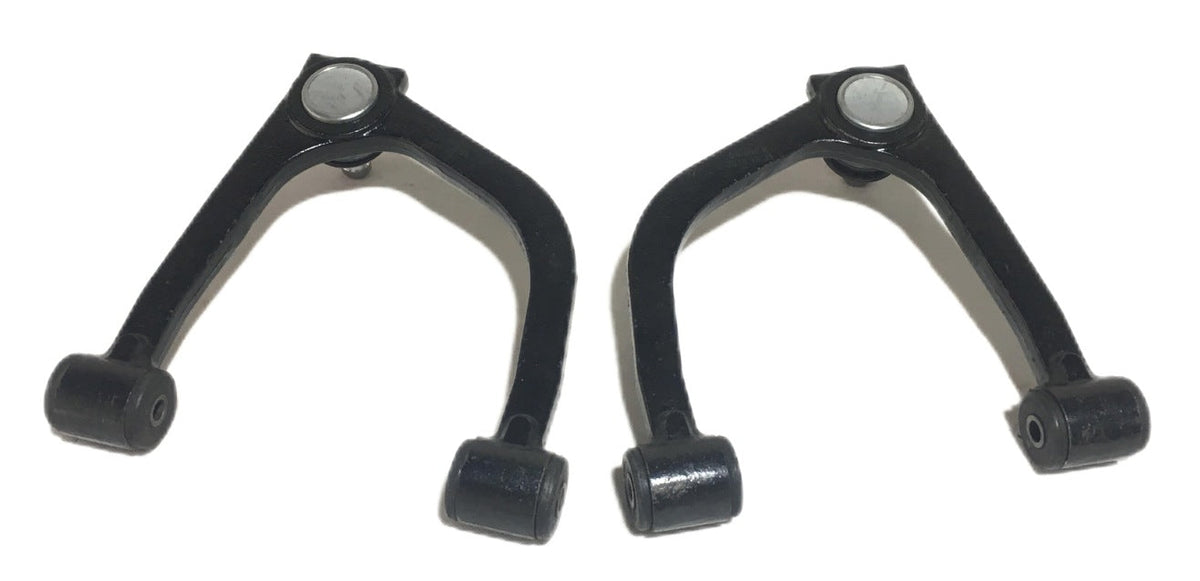
Short answer: if a Falcon's ball joint is worn and the bushes in that arm are tired too, a complete replacement arm is often the quicker and simpler fix. You unbolt the old arm and bolt the new one in. There's no pressing out a seized joint, no press to hire, and you're not putting one new part into an arm whose bushes have done the same kilometres. Pressing in just a joint still makes sense when the arm and bushes are in good shape and you have the press to do it. Either way, book a wheel alignment afterwards.
A ball joint is the pivot between a control arm and the steering knuckle. It lets the wheel move up and down and steer at the same time, and when it wears, the wheel can move in ways it shouldn't. This guide covers the BA, BF, FG and FGX, with the AU where its arms are shared.
What are the signs of worn ball joints or control arms on a Falcon?
Worn ball joints and control arm bushes usually show up as:
- A clunk or knock from the front over bumps, driveway lips or speed humps.
- Steering that wanders or feels vague on the highway.
- Uneven tyre wear, especially on the inside or outside edge.
- The car pulling or shifting under brakes.
- A split or greasy rubber boot on the ball joint.
- Cracked, perished or squashed rubber in the arm bushes.
- An alignment that won't hold, or an aligner telling you there's play in the front end.
Worn sway bar links, tie rod ends and shock or strut mounts can make the same noises, so have the suspension checked before you buy parts.
How is a ball joint checked?
- The car is lifted and safely supported on stands or a hoist, never on a jack alone.
- The wheel is levered or rocked top to bottom while someone watches the joint for movement.
- The boot is checked for splits and escaping grease.
- The arm bushes are checked by watching for the arm shifting where it mounts to the car.
Suspension parts are safety items. If you're not set up to do this, any suspension or alignment shop can check it for you.
BA–BF and FG–FGX front ends: what's different?
On a BA or BF, each side of the front has an upper control arm and one lower control arm, each with its own ball joint. The BA–BF front lower arm is sold each, as a left or a right. The FG and FGX front end uses two separate lower links each side instead of a single lower arm, so check exactly which part is worn before you order. We list FG–FGX front upper control arms; text us about the FG lower links.
Pressing in a new ball joint: what the job involves
Depending on the arm, the ball joint may be pressed in, riveted, bolted in or part of the arm itself. Your workshop manual or parts supplier will tell you which applies to your car. Where it's a press fit, replacing just the joint usually means:
- Getting the car up and safely supported, and the wheel off.
- Separating the joint from the knuckle, and often taking the arm or knuckle off to get it under a press.
- Pressing the old joint out. A joint that has been in for years can be seized in its bore and fight you the whole way.
- Pressing the new joint in square, without damaging the bore.
- Refitting everything, tightening it to the factory workshop manual figures, then getting an alignment.
That needs a hydraulic press or a ball joint press kit, which most home mechanics don't own. A workshop charges labour for every step, and a seized joint adds to it. You end up with one new joint in an arm whose bushes are as old as the joint you took out.
Fitting a complete replacement arm
A complete arm is one assembly: the arm with its ball joint and bushes already in it, ready to bolt in. The job becomes:
- Car up and safely supported, wheel off.
- Free the ball joint from the knuckle and undo the arm's mounting bolts.
- Bolt the new arm in, tighten it to the workshop manual figures and refit the wheel.
- Get a wheel alignment.
Nothing gets pressed into or out of the arm. What that means in practice:
- Less labour. A workshop isn't billing you to press parts in and out, so the bill is often lower, even though a whole arm costs more than a joint on its own.
- A realistic driveway job. If you can support the car safely and use a torque wrench, it's often within reach at home.
- Fresh bushes and ball joint in one go. The bushes aren't the next job.
- Back on the road sooner. No waiting on a press or a seized joint.
FalcX replacement control arms are direct replacements for the factory arm: take the old arm out, fit the new one in its place.

Replace the arm or press in a joint? Side by side
| Complete arm | Press in a new joint | |
|---|---|---|
| What's renewed | The arm, with its ball joint and bushes | The ball joint only |
| Tools | Hand tools, jack and stands or a hoist, torque wrench | The same, plus a press or ball joint press kit |
| Work involved | Unbolt the old arm, bolt in the new one | Remove, press the old joint out, press the new one in, refit |
| Seized parts | Nothing to press out | A seized joint can turn a short job into a long one |
| Parts cost | Higher: a whole arm | Lower: just the joint |
| Labour | Often less | Often more |
| Bushes | New | As they were |
| Wheel alignment after | Yes | Yes |
When does pressing in just a joint make sense?
A complete arm isn't always the answer. Pressing in a joint can be the better choice when:
- The arm is straight, not corroded, and its bushes are in good condition.
- Your arm takes a replaceable joint, and you or your workshop have the press to do it.
- You're running aftermarket arms you want to keep.
- There's no complete arm listed for your series and body style.
If an arm is bent, cracked or badly corroded, replace the arm whatever the joint is doing.
Which arm is which on a Falcon?
These are the names used on our listings.
- Front upper control arm. The upper arm of the front suspension, carrying the upper ball joint.
- Front lower control arm. The lower arm, carrying the lower ball joint. The FG and FGX use two separate lower links each side instead.
- Rear upper control arm. Part of the independent rear suspension on BA to FGX sedans.
- Rear toe arm. A rear lower arm on FG and FGX sedans. BA and BF use a different, shorter toe arm.
- Rear blade trailing arm. The rear lower trailing arm on BA to FGX sedans, also called the blade arm or control blade.
- Rear trailing arms on live-axle Falcons. Upper and lower arms on solid rear axle sedans: XE–XF, EA to EL, and AU with a live rear axle.
Rear arms don't carry a ball joint. Their wear is in the bushes, and the same logic applies: a new arm saves pressing old bushes out of the old one. Check the "What's included" list on each listing for what comes with it.

Which FalcX arm fits my Falcon?
Fitment below is as each listing states it. Check your series, build date and body style against the listing before you order, and compare the part with the arm on your car. XR6, XR6 Turbo, XR8 and FPV models are built on the same BA–BF or FG–FGX Falcon, so they take the arms listed for their series and body style.
| Arm | Fits (as listed) | Sold as |
|---|---|---|
| AU and BA–BF front upper control arms | BA and BF, 2002–2008; AU Series I, II and III including wagon, ute and cab chassis. Not for RTV utes. | Pair |
| BA–BF front lower control arm | BA and BF sedan, wagon and ute. Not for RTV utes. Not listed for AU. | Each, left or right |
| FG–FGX front upper control arms | FG and FGX sedan and ute, and FPV FG | Pair |
| BA–FGX rear blade trailing arms | BA and BF sedans; FG and FGX sedans and FPV. Not for utes or wagons. | Pair |
| FG–FGX rear toe arms | FG and FGX sedans. Not for the BA or BF. | Pair |
By series: BA–BF Falcon control arms and FG–FGX Falcon control arms. AU owners take the AU and BA–BF front upper arms. We don't have arms listed for EA to EL or XE–XF right now; text us with your series and which arm you need. Everything is in Ford Falcon replacement control arms, and coilover fitment by series and body style is in the fitment guide.
After the new arms go in
- Tighten everything to the factory workshop manual figures. Some bush bolts are meant to be tightened with the car at ride height; the manual says which.
- Get a wheel alignment. New arms change where the wheel sits, so camber and toe need setting. See wheel alignment after lowering a Falcon for what to ask the aligner.
- Check the other side. If one side is worn, the other has done the same kilometres.
- Lowered car and the alignment won't come into range? That's a job for adjustable arms. FalcX adjustable arms are in development.
Doing coilovers at the same time? Install and setup covers the order of jobs, and one alignment at the end covers both.
Not sure which arm you need? Text 0449 887 291 with your series, body style and what you're noticing.
Common questions
Can I replace just the ball joint on my Falcon?
Where your arm takes a replaceable joint, yes. You'll need a press or a ball joint press kit, or a workshop to do it.
Do FalcX arms come with the ball joint and bushes fitted?
Check the "What's included" list on each listing. The AU and BA–BF front upper arms and the BA–BF front lower arm are pictured with the ball joint and bushes fitted. For the FG–FGX front upper arms, that's being confirmed before sale. Rear arms have no ball joint; the rear blade trailing arms come with polyurethane bushes and inner sleeves.
Do I need a wheel alignment after replacing control arms?
Yes. A new control arm changes where the wheel sits, so get the camber and toe set once the arms are in.
Are FalcX replacement arms adjustable?
No. They're direct replacements for the factory arms, for owners who don't need adjustment. Adjustable arms for lowered BA–FGX sedans are in development.
Will they fit my XR6, XR8 or FPV?
Yes, when the arm is listed for your series and body style. XR and FPV models share the suspension mounting of their BA–BF or FG–FGX Falcon.
Should I replace both sides?
If one side is worn, check the other: it has done the same kilometres. The BA–BF front lower arm is sold each, so order a left and a right to do both sides. The other arms are sold as pairs.


